Vergina & Pella Day Trip - Macedonian Heritage Exploration
Dive deep into the glorious past of ancient Macedonia with Transfer SKG's all-inclusive Vergina and Pella archaeological excursion departing from Thessaloniki. This historical 5-6 hour voyage transports you to 6 of Greece's most remarkable ancient landmarks: the legendary royal burial grounds of Vergina, which houses the tomb of King Philip II (father to Alexander the Great), alongside ancient Pella, the sprawling capital of the Macedonian kingdom and the birthplace of Alexander the Great himself. You won't have to worry about directions thanks to our seamless private transport, while our professional driver shares rich historical context, linking these archaeological marvels to the golden era of Macedonia when it reigned supreme over the ancient Greek world.
Vergina and Pella day tour Transfer SKG
Vergina Greece and the Pella archaeological site collectively narrate the fascinating ascent of Macedonia from a modest regional territory to an ancient superpower under the rule of Philip II and his heir, Alexander. The Vergina museum safeguards mesmerizing golden relics unearthed from pristine royal tombs, while the sprawling remnants of Pella showcase the advanced urban design and artistic triumphs of the Macedonian capital. Merging these two destinations delivers unmatched perspectives on the royal lineage that altered the course of human history, rendering it a must-do for admirers of archaeology, history lovers, and those captivated by the enduring mythos of Alexander the Great. Uncover the magic of ancient Macedonia with our Vergina & Pella Day Trip to these archaeological wonders! Navigate back to Transfer Thessaloniki Airport to discover additional excursions. Unearth the final resting place of Philip II and the hometown of Alexander the Great. It serves as an ideal pairing with our Meteora Day Trip from Thessaloniki and the Mount Olympus & Dion Day Trip. Don't forget to check out the Loutra Pozar & Edessa Waterfalls Tour to witness breathtaking natural beauty. We offer both Group Transfer and Private Transfer choices.
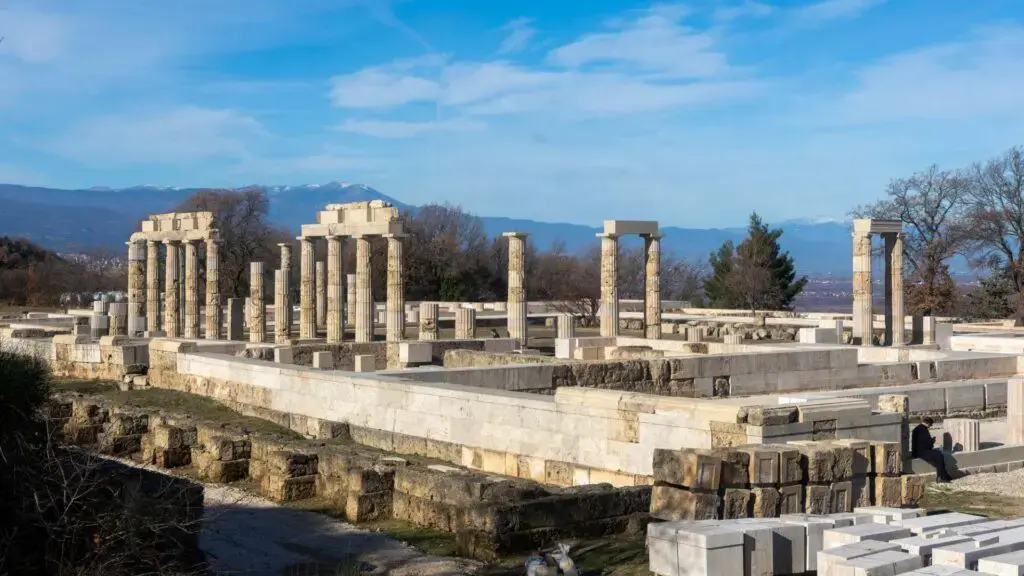
The Royal Tombs of Vergina
Vergina stands as one of the most spectacular archaeological breakthroughs of the 20th century. During 1977, the renowned Greek archaeologist Manolis Andronikos brought to light the untouched tomb of Philip II hidden beneath the Great Tumulus at ancient Aigai (present-day Vergina). The Vergina tombs safeguarded extraordinary riches: a golden larnax (ossuary chest) cradling cremated bones bearing the iconic Vergina star emblem, detailed golden wreaths, majestic armor, and imperial insignia that had lay completely concealed for more than 2,300 years. This monumental find definitively proved that Vergina was indeed ancient Aigai, the original capital of Macedonia and the hallowed burial ground for its royalty.
Inside the Vergina Museum
Constructed right inside the earthen mound to maintain the tombs exactly where they were found, the Vergina museum delivers an evocative subterranean journey. As visitors walk down into the climate-regulated exhibition space, they are met with Philip II's tomb and its breathtaking facade, the golden treasures illuminated under soft lighting to preserve their delicate state, and the profound experience of standing directly before authentic royal graves. The sun of Vergina (or Vergina star) - a 16-ray bursting star symbol identified across numerous relics - has grown into a defining emblem of Macedonian history, even though historians continue to debate its precise ancient significance. Plus, the museum encases the resting places of other royal figures, quite possibly including Alexander IV (the son of Alexander the Great), effectively forming a complete royal necropolis.
Vergina Museum Opening Hours and Practical Information
Knowing the Vergina museum opening hours is key to flawlessly planning your trip. The ruins and museum welcome visitors from April through October between 8:00 AM and 8:00 PM every day. From November to March, operating times shift to 8:00 AM until 3:00 PM on weekdays, remaining closed on Mondays. The lengthier daytime hours throughout the summer allow for adaptable scheduling, though arriving in the morning is recommended to dodge heavy foot traffic and capture the best lighting inside the subterranean halls. Admission fees stand at €12 for adults, while special markdowns are extended to seniors, university students, and EU citizens under 25. Since combined passes with nearby attractions are unavailable, you will need to purchase separate entry tickets for Vergina and Pella.
- The Great Tumulus Museum: Serving as the primary subterranean exhibit embedded within the burial mound, it displays Philip II's grave, the crypt of the so-called "Prince," and an extensive collection of golden treasures, ancient weaponry, and imperial goods pulled directly from the excavation site.
- Palace of Palatitsia: These are the surviving foundations of an expansive royal estate perched on an adjacent hillside, widely thought to be the very location where Alexander the Great was born. The spot grants sweeping views across the Macedonian plains and helps illustrate the grand design of the ancient royal metropolis.
- Ancient Theater: Dating back to the 4th-century BC, this is the exact semicircular stone venue where Philip II met his end via assassination in 336 BC - a pivotal assassination that ultimately handed the Macedonian crown to Alexander. Its stone seating remains in incredibly good condition.
- Polycentric Museum: Functioning as a modern exhibition wing, it displays findings extracted from various graves and digs across the ancient city, featuring ordinary household items that shed light on the daily existence in Macedonian Aigai beyond the royal burials.
Ancient Pella - Birthplace of Alexander the Great
Around 400 BC, under the rule of King Archelaus, ancient Pella ascended as the new capital of Macedonia, usurping Aigai as the epicenter of the kingdom's political power. The Pella archaeological site unveils a highly advanced Hellenistic metropolis defined by precise grid-like avenue planning, luxurious private residences adorned with magnificent floor mosaics, massive civic structures, and a sprawling agora (central marketplace). As the birthplace and childhood residence of Alexander the Great, Pella is where he was tutored by Aristotle prior to launching his legendary military campaigns that conquered the globe. Propelled by the prosperity achieved during the reigns of Philip II and Alexander, the city blossomed into one of the most magnificent capitals of ancient Greece before experiencing a slow deterioration post-Roman occupation.
The Pella Mosaics
The legendary Pella mosaics stand out as the location's absolute crown jewels - intricate pebble artworks located in affluent estates that portray complex mythological narratives with extraordinary artistic refinement. Standout pieces, such as the depiction of Dionysus astride a panther alongside a fierce lion hunt, highlight the elite aesthetic standards maintained in Macedonia's wealthiest households. These mosaics have been preserved directly in place under sheltering pavilions, ensuring that modern tourists can marvel at them exactly where they were meant to be seen. While the royal palace of Pella is not quite as well-preserved as the residential districts, its surviving foundations highlight the sheer magnitude of the royal architecture inhabited by Philip II and a young Alexander prior to their military campaigns that forever altered the globe.
Pella Archaeological Site and Museum
The Pella Greece attraction encompasses a vast open-air archaeological park coupled with a contemporary museum that catalogs the extraordinary artifacts found during extensive digs. Inside the museum, guests will find curated displays of ceramics, classical sculptures, ancient inscriptions, and smaller relics that paint a vivid picture of everyday life in ancient Pella. Highlighted pieces include fascinating terracotta figurines, historic weapons, and household tools that reflect the vibrant material culture during Macedonia's golden era. Educational exhibits throughout the facility detail Pella's vital historical role and track Macedonia's dramatic evolution from a localized kingdom into a massive empire spearheaded by Philip and Alexander.
Tour Itinerary and Logistics
Time | Activity | Duration |
|---|---|---|
9:00 AM | Departure from Thessaloniki | - |
9:00-10:00 AM | Drive to Vergina (80 km) | 1 hour |
10:00 AM-12:00 PM | Explore Vergina museum, tombs, and theater | 2 hours |
12:00-12:30 PM | Drive to Pella (40 km) | 30 minutes |
12:30-2:00 PM | Visit Pella archaeological site and museum | 1.5 hours |
2:00-3:00 PM | Lunch at traditional taverna | 1 hour |
3:00-3:45 PM | Return drive to Thessaloniki (45 km) | 45 minutes |
3:45 PM | Arrival back in Thessaloniki | - |
This timetable ensures you have plenty of time at every destination without feeling hurried, granting you the chance to fully absorb the intricate historical facts and admire the archaeological nuances. The schedule can easily be adapted to suit your preferences - aficionados of history frequently ask for extra time inside the Vergina museum to meticulously examine the relics, whereas others might opt to linger over a leisurely lunch at an authentic Macedonian taverna. You will find countless spots to take photographs at both locations, but please note that snapping pictures inside the Vergina museum is restricted to shield the fragile golden artifacts from potential flash degradation.
Transportation and Pricing
Transfer SKG delivers premium private transit from Thessaloniki out to Vergina and Pella aboard our reliable Peugeot 307 Station Wagon, perfectly sized for groups of up to 4 passengers. This combined Vergina Pella Greece excursion spans a total driving distance of roughly 165 kilometers, guiding you across the lush Macedonian plains where these mighty ancient realms once thrived. In stark contrast to crowded coach tours that stick to strict itineraries and offer minimal time on-site, our private transport service gives you the ultimate freedom to modify the schedule, prolong your stay at the spots you love most, or even make impromptu pit stops at scenic overlooks and hidden gems our driver is familiar with.
The cost for our Macedonian heritage adventure begins at an attractive €150-180 per vehicle (covering every passenger), presenting an incredibly cost-effective option for couples or small travel parties when compared to booking individual tours. This fee covers your round-trip transit, a seasoned driver eager to share historical context and manage the day's logistics, and a fully customizable schedule. Please be aware that the price excludes admission tickets (€12 per individual for Vergina, €8 for Pella), taverna meals (which generally run €12-18 per guest for hearty Macedonian cuisine), and any extra optional activities. This excursion provides extraordinary bang for your buck when factoring in the colossal historical magnitude of these two destinations paired with the sheer ease of a dedicated, door-to-door transfer service.
Best Time to Visit
You can embark on a Vergina and Pella excursion at any point during the year, as every season boasts its own unique perks. During the Spring (April to May), the Macedonian plains burst into color with wildflowers, the climate is perfectly comfortable for walking around outdoor ruins, and the tourist crowds are noticeably thinner than in summer. The Summer season (June to August) promises brilliant sunny skies, though it also brings intense heat and the highest density of visitors; fortunately, the subterranean Vergina museum offers a brilliantly air-conditioned escape. Autumn (September to October) is widely considered optimal, delivering balmy weather, spectacular sunlight for snapping photos, and very manageable crowd sizes. Wintertime brings sparse crowds and a uniquely moody atmosphere, but visitors must verify the seasonal museum hours and pack appropriately for the cold while wandering the exposed outdoor dig sites.
What to Bring
Making the most of an archaeological expedition requires a bit of smart packing. Sturdy, comfortable walking footwear is absolutely necessary to navigate the irregular landscapes of the outdoor excavations. For summer outings, when sun exposure is intense, make sure to pack protective gear such as shades, a sun hat, and sunscreen. Don't forget your camera to immortalize the stunning ancient architecture and artifacts, but remain mindful of the strict photo rules inside the Vergina museum where flashes might degrade the ancient materials. Carrying a refillable water bottle is essential to beat the heat, particularly during the sweltering months. Having a modest amount of physical cash on hand is incredibly helpful for covering your entry tickets, midday meals, and any trinkets you might want to purchase at the museum gift shops. Lastly, dressing in light, breathable layers is highly recommended to seamlessly transition between the hot outdoor environments and the crisp, climate-controlled air inside the museums.
Historical Context and Significance
Pairing the sites of Pella and Vergina brilliantly illuminates Macedonia's dramatic metamorphosis from an outlying Greek territory into the dominant force of the ancient era. The strategic brilliance of Philip II both on the battlefield and at the diplomatic table successfully consolidated Greece beneath Macedonian supremacy, while his tragic assassination within the theater of Vergina abruptly thrust a youthful Alexander into power, tasking him with executing his father's grand invasion of Persia. The subsequent victories of Alexander disseminated Greek civilization throughout the known globe, sparking the dawn of the Hellenistic epoch. The tombs at Vergina offer an irreplaceable, physical bond to these monumental architects of history, while the rubble of Pella exposes the intellectually advanced society that molded them. Ultimately, this excursion bridges the birthplace of Alexander the Great with the majestic tomb of his father, perfectly framing the royal bloodline that reshaped the trajectory of global history.
Booking Your Vergina & Pella Tour
Lock in your Macedonian heritage experience by reaching out to Transfer SKG over the phone (+30 699 700 0090), through WhatsApp/Viber, or by dropping us an email. Kindly share your requested travel date, your exact Thessaloniki pickup spot, the number of people in your party, and any distinct interests you hold (such as a deep dive into archaeology versus a broader historical overview, specific photography goals, or a desire to spend extra time at a particular location). To guarantee your preferred date, we highly advise finalizing your reservation a minimum of 5-7 days beforehand, particularly if you plan to travel during the bustling summer season. We will collaborate with you to determine the absolute best departure time in accordance with the attractions' operating hours, tailoring a bespoke schedule that guarantees you squeeze every drop of historical wonder out of ancient Macedonia's crown jewel archaeological sites.
Important Booking Information
Night Rate: Should your transfer be slated to commence after 0:00 local time, a special premium fee will be applied. We kindly ask that you validate this exact cost alongside our booking manager when arranging your late-night transit.
Return Transfer Discount: Travelers can unlock a special markdown when coordinating a return trip. Please consult our management staff to learn the specifics. Reserving a two-way transfer package is invariably the smartest move to secure the greatest value.
Free Cancellation: You are entitled to a full, penalty-free cancellation provided you notify us a minimum of 24 hours ahead of your scheduled departure. Cancelling inside that 24-hour window may result in the application of a cancellation charge.